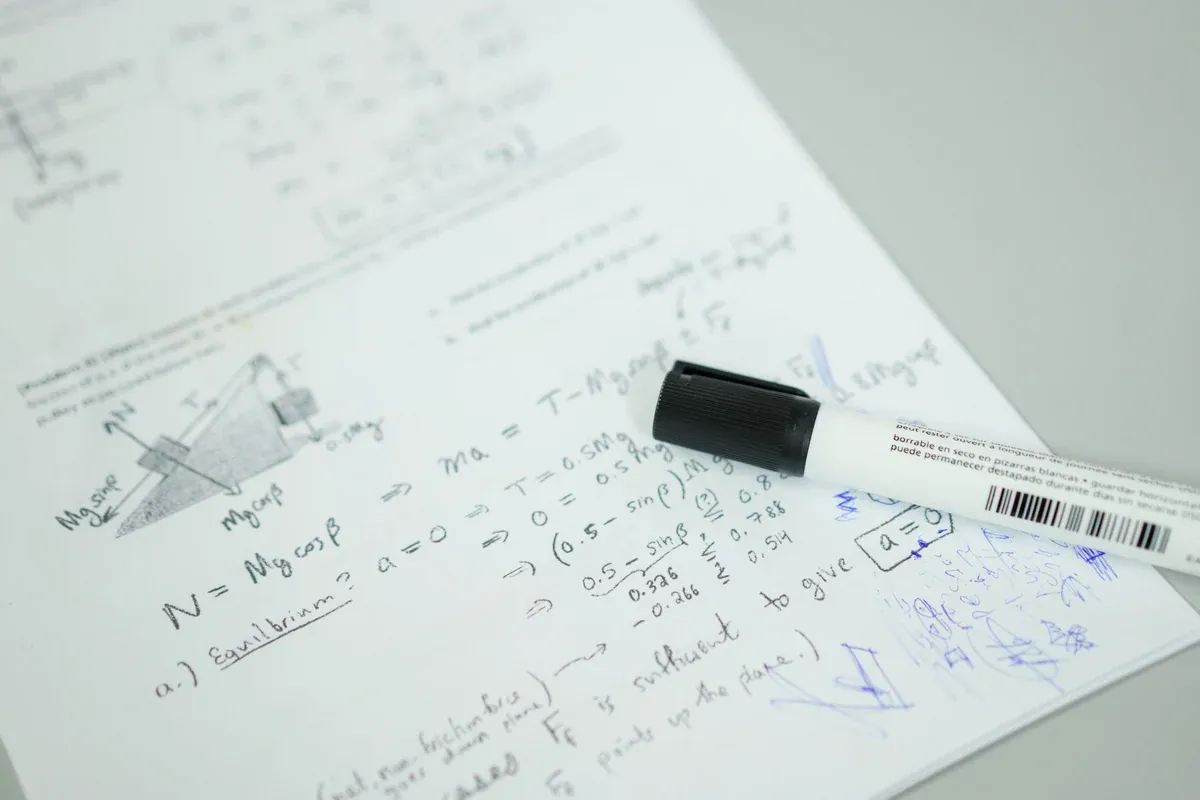
Study for calculus by running a repeatable problem loop. Name the assessment and the concepts or skills it will assess, attempt one assigned problem with notes closed, compare it with a course-approved answer or solution, find the earliest incorrect or unsupported step, and choose an analogous problem that tests the same idea.
This approach rejects two common low-value starting points. Do not begin by rereading every note in order, and do not open a solution before you have tried to select a method. Your next problem should come from the exam's assessed scope and from evidence in your own work that a specific idea needs attention.

Turn assigned work into an exam map
Start with the next exam rather than the entire course. Group assigned calculus problems into manageable sections based on the course's learning objectives or assessed content. The section names should come from your instructor's materials, such as limits, derivative applications, integration methods, or any narrower categories on the review sheet.
- Collect the current scope Put the syllabus, exam announcement, instructor review sheet, recent notes, homework, and permitted formula sheet in one place. Exam conditions vary by course, so use those current documents rather than assuming another class's rules apply.
- Sort problems by assessed idea Place each assigned problem under the objective it primarily tests. If a problem combines ideas, put it under the step you would have the most difficulty choosing without notes.
- Choose the first target Select an objective that is in scope and for which you cannot yet start a representative problem independently. If two objectives are equally uncertain, begin with the one that appears more often in the instructor's assigned review, without assuming that frequency guarantees exam weight.
A useful map can fit on one page. Write each objective as a heading, list two or three assigned problem numbers beneath it, and leave space for one error note. Elaborate summaries can wait because the immediate decision is which problem will reveal what you can do without support.
Attempt before you inspect a solution
Worked solutions are checking tools, not substitutes for the first attempt. Cover the answer, work from the prompt, and state why each important step applies. Naming the theorem, rule, substitution, or algebraic move makes your reasoning visible enough to inspect after the attempt.
- Match the exam conditions Use only the notes, formula sheet, calculator, or other resources your instructor will permit. If the exam requires shown work, practice a complete written solution rather than an answer-only shortcut.
- Make a serious independent attempt Keep the solution covered while you identify the goal, choose a method, and carry it through. If you cannot begin, write down the method you considered and the exact decision that blocked you before consulting an approved source.
- Check every line After completing the attempt, compare the method and result with a course-approved answer. Review the algebra and notation step by step, then ask whether the result is reasonable for the prompt instead of checking only the final value.
Why the attempt comes first In one US introductory biology course, students who chose answer-before-feedback reviews later scored higher than peers who chose read-only reviews or none. Students selected their own review mode, however, and the course was not calculus. A university statistics experiment also did not show that self-explanation quality mediated worked-example gains in its task. Use an independent attempt and step narration as diagnostic discipline, not as a score promise or universal causal effect.
Run the loop on one worked calculus problem
The following source-checked example shows the process. It is not a prediction of what will appear on your exam. After following the loop once, replace it with a problem from the textbook, notes, or problem set your instructor assigned.
- Make the independent attempt Let F(x) = the integral from 1 to sqrt(x) of sin(t) dt. Find F'(x). Before reading the next step, cover it and write the derivative using the rules from your course.
- Explain the two key moves The Fundamental Theorem gives sin(sqrt(x)), and the chain rule contributes the derivative of sqrt(x), which is 1 / (2 sqrt(x)). This explanation identifies why the extra factor appears rather than treating it as a memorized decoration.
- Check against the source The source result is F'(x) = sin(sqrt(x)) / (2 sqrt(x)). Compare your work line by line. If you wrote only sin(sqrt(x)), the earliest unsupported step is where you applied the theorem to a variable upper limit without including the derivative of that upper limit.
- Choose the analogous retry Next, choose an assigned problem that again differentiates an integral with a variable upper limit but changes the integrand or upper function. The underlying decision stays the same while the surface details prevent you from merely copying this result.
If you want another practice format after doing the handwritten work, Testopia's PDF to quiz generator can use your own course files. Testopia is our product, so treat it as a convenience option rather than independent evidence of better calculus learning. The tool accepts PDF, DOCX, or PPTX materials and generates multiple-choice practice with a review of missed questions. Use it for bounded checks such as terminology or rule selection, but keep doing written problems when your instructor grades the method and steps.
Let the first error choose the next problem
Do not record only that the answer was wrong. Record the earliest incorrect or unsupported step and give it a simple course-relevant label. That first break usually gives you a clearer next target than every later consequence of the same mistake.
Method selection error
Practice choosing the rule
- You could not explain which theorem, rule, or substitution fit the prompt.
- Choose an assigned problem with the same underlying idea and different functions, values, or wording.
Execution error
Practice the failed operation
- You chose an appropriate method but made an algebraic, derivative, or notation error.
- Use a simpler assigned item that contains the same operation, then return to a course-level problem.
Communication error
Practice a complete written solution
- Your result matched, but required reasoning or notation was missing.
- Rewrite one assigned solution in the format shown by your instructor, explaining the reason for each key step.
Reasonableness error
Add a final interpretation check
- Your calculations produced a result that did not fit the behavior described in the prompt.
- For the next problem, pause before checking the key and state what sign, size, or form would make sense.
Keep the record short. Write the problem number, the first error, its label, and the next problem you selected. If the analogous attempt is clean and fully justified, move to another objective instead of repeating mechanically. If the same error returns, pause random practice and revisit the assigned example or ask for help with that exact step.
Adjust the plan to the days remaining
3 to 4 days
Prioritize coverage and diagnosis
- Map every assessed objective, then attempt one representative assigned problem from each.
- Spend the remaining practice on objectives that produced method errors or blocked starts.
- Use the final session to practice under the current exam's permitted-resource rules.
5 to 9 days
Add a targeted second pass
- Complete the first representative pass early enough to identify weak objectives.
- Retry analogous assigned problems after diagnosing the first errors.
- Finish with a mixed group that makes you choose methods without topic labels.
10 to 14 days
Use several shorter objective passes
- Map and sample the full scope first instead of spending the opening days on one chapter.
- Return to uncertain objectives between work on other in-scope topics.
- Include at least one mixed, closed-note session in the format your instructor expects.
For every time window, deprioritize rewriting notes you already understand, searching randomly for harder internet problems, and polishing topics that repeatedly produce clean work. The decisive variable is not how many pages you touch. It is whether your checked attempts reveal an in-scope idea that you still cannot select, execute, or explain independently.
Choose one problem now
- Open the exam scope Choose one objective from the instructor's current review materials that you cannot yet demonstrate without support.
- Attempt one assigned problem Close the solution, show each step, and write a short reason beside every important rule or transformation.
- Make the next decision Check the attempt, circle the first unsupported step, and select one analogous assigned problem. Stop expanding the study plan until you have completed that loop once.
Sources
- Students' Use of Optional Online Reviews and Its Relationship to Summative Assessment Outcomes in Introductory Biology
- Learning to solve ill-defined statistics problems: does self-explanation quality mediate the worked example effect?
- Facilitate a Student-Created Study Guide
- 18.01 Calculus: Problem Set 4
- Problem Set 3 | Single Variable Calculus
- Introduction
- Math 16B: Short Calculus, Second Quarter Syllabus
- 1.3 The Fundamental Theorem of Calculus
- PDF to Quiz Generator | Create AI Tests with Explanations
Photography

Stop rereading. Start testing yourself.
Open Testopia on your phone to turn your study documents into quizzes and flashcards.