Learning Science
The Neuroscience of High-Performance Learning
Why Active Recall and Spaced Repetition are the Ultimate Power Couple
Have you ever spent an entire weekend highlighting a textbook, only to find yourself staring blankly at a midterm on Monday morning? If so, you’ve encountered the illusion of competence. This psychological trap occurs when passive study habits, like rereading and underlining, make material feel familiar without actually moving it into long-term memory.1 At Testopia, we believe that studying shouldn't be a marathon of frustration; it should be a surgical application of cognitive science.
The secret to durable learning doesn’t lie in how much you study, but in how your brain processes information. Decades of peer-reviewed research in cognitive psychology have identified two specific strategies that, when combined, create a synergy more powerful than any other method: Active Recall and Spaced Repetition. Together, they form the bedrock of the Testopia philosophy. In this article, we’ll dive deep into the neuroscience of why these methods work and how you can apply them to achieve academic mastery with less stress.
The Power of Active Recall
The Testing Effect: Learning through Retrieval
Active Recall, also known as retrieval practice, is the process of actively pulling information from your brain rather than trying to push it in. Conventional wisdom suggests that testing is a way to measure learning. However, research pioneered by Roediger and Karpicke2 reveals that testing is actually a way to produce learning.
In a landmark study, researchers found that students who practiced free recall (writing down everything they remembered) after reading a passage retained significantly more information over the long term than those who simply restudied the text. While the 'restudy' group performed better on a test given five minutes later, they suffered a massive forgetting rate over the following week. Conversely, the active recall group retained nearly double the information after seven days (Roediger and Karpicke2).
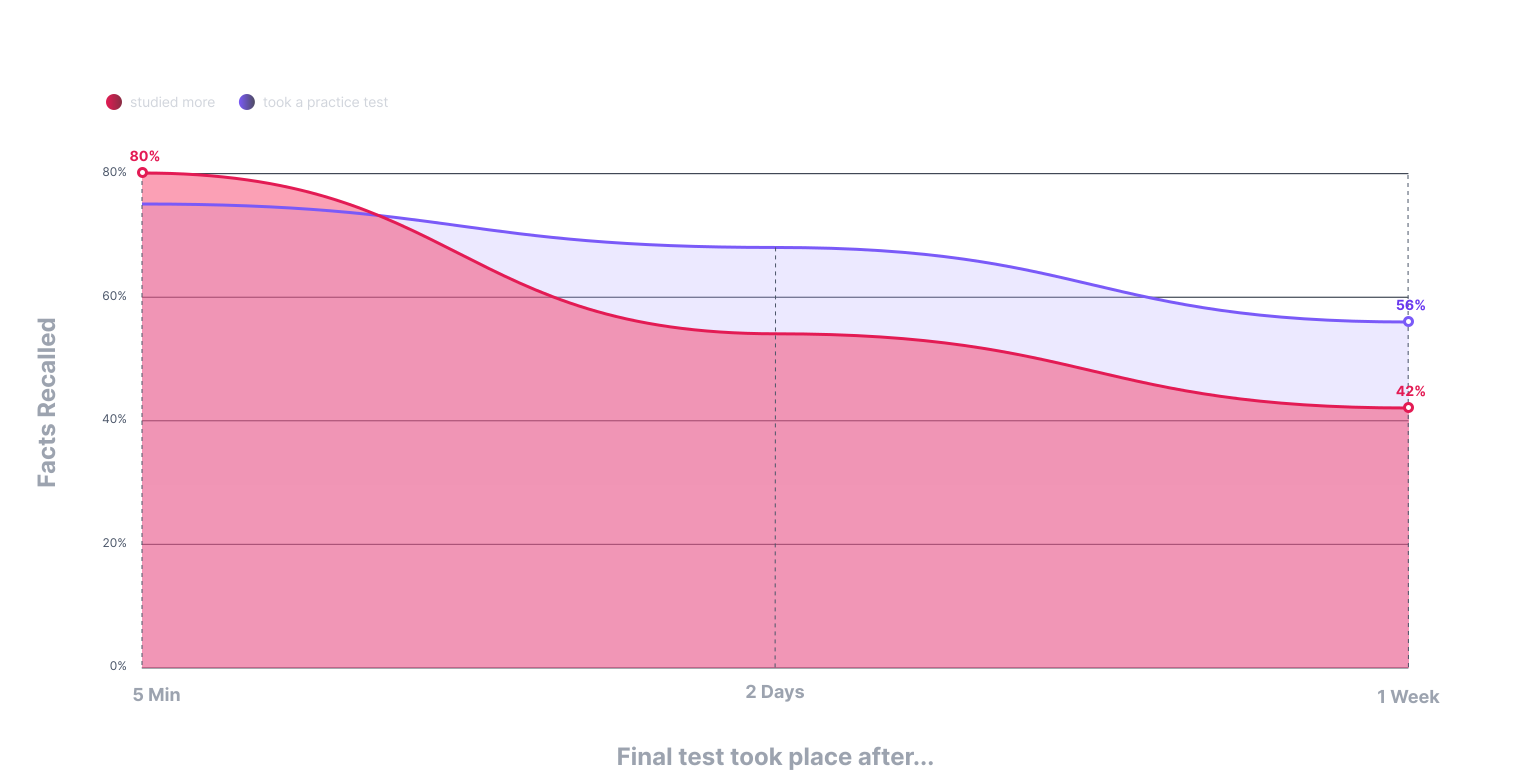
FIGURE 1: Retrieval Practice vs. Restudying Performance Over Time2
The Cognitive Effort Hypothesis
Why is retrieval so effective? Neuroscientists point to the cognitive effort hypothesis. When you struggle to remember a fact, your brain is forced to reconstruct that memory trace. This effortful process signals to the brain that the information is important. Unlike passive reading, which is cognitively 'cheap', active recall is a 'desirable difficulty'12. It strengthens the neural pathways (synaptic connections) associated with that memory, making it easier to access in the future.
The Logic of Spaced Repetition
Ebbinghaus and the Forgetting Curve
While active recall tells us how to review, Spaced Repetition (also known as distributed practice) tells us when to review. This principle dates back to the late 19th century and the work of Hermann Ebbinghaus. Through self-experimentation, Ebbinghaus discovered the forgetting curve: the exponential rate at which we lose new information if we don't review it19.
He found that we lose roughly 50% of new information within 24 hours. However, he also discovered a solution: every time we review the material, the rate of forgetting slows down. By spacing out your reviews, you can 'flatten' the forgetting curve, eventually requiring only occasional check-ins to maintain a memory for years.
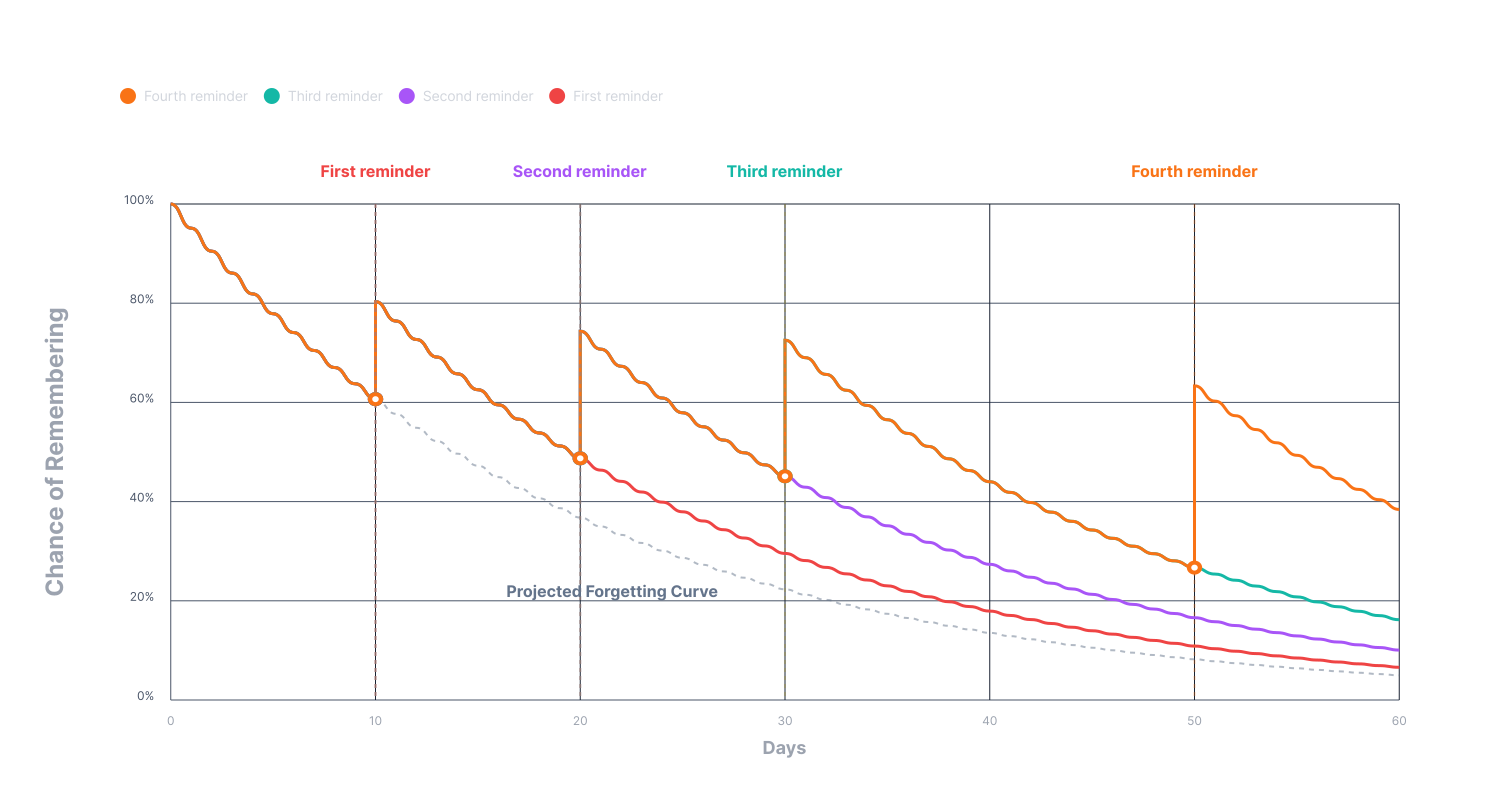
FIGURE 2: The Spaced Repetition Forgetting Curve19
Optimal Spacing Intervals
But how long should the spaces be? Research by Nicholas Cepeda and colleagues (2008) analyzed over 1,300 participants to find the 'sweet spot' for spacing.4 They discovered that the optimal gap between study sessions depends on how long you need to remember the information.89
For example:
- 1 week before the exam: Review every 1-2 days.
- 1 month before the exam: Review every 5-7 days.
- 6 months before the exam: Review every 25-30 days.
A general rule of thumb derived from this research is that the review interval should be approximately 10% to 20% of the desired retention time9.
The Synergy - Why They Work Better Together
1 + 1 = 3: Spaced Retrieval
The true magic happens when you combine these two methods into Spaced Retrieval Practice. We at Testopia often compare this to fitness: active recall is the 'intensity' of the workout (how hard you push your memory), while spaced repetition is the 'rest and recovery' (giving your brain time to consolidate). Just as you wouldn't do 1,000 pushups in a single day and expect results, you shouldn't 'cram' 1,000 facts in a single night.
When you wait until you are just about to forget a fact and then force your brain to recall it, you are maximizing the reconsolidation process. Every time a memory is retrieved and then restored, it becomes more deeply embedded in the neocortex, eventually becoming independent of the hippocampus - the brain's 'temporary' storage hub22.
Retrieval Practice as a Shield Against Stress
Recent research has added another layer to this synergy: stress protection.10 A study published in Science by Smith et al. (2016) found that students who used retrieval practice were virtually immune to the memory-impairing effects of acute stress. Participants were taught material using either restudying or retrieval practice.711 Twenty-four hours later, half were subjected to a stressful situation before a final test. Those who had restudied saw their scores plummet under stress, while the retrieval practice group showed no impairment whatsoever20. For students with test anxiety, the combination of active recall and spacing isn't just a study tip - it's a performance insurance policy.
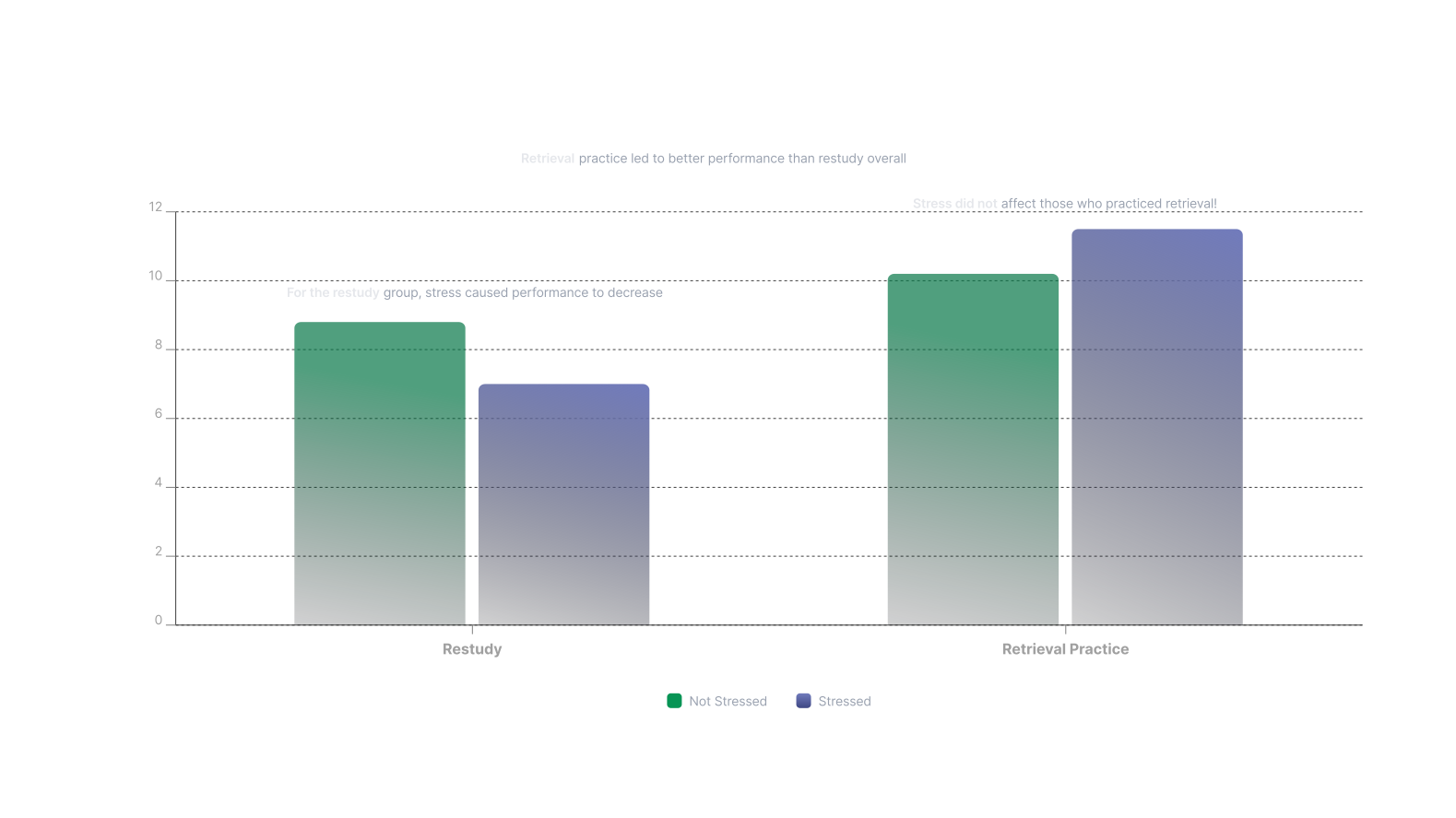
FIGURE 3: Impact of Stress on Memory Retrieval20
Practical Implementation for Students
How to Move Beyond Passive Review
Transitioning from highlighting to active retrieval can feel uncomfortable at first. This is because active study strategies are cognitively demanding. However, this discomfort is a sign of actual learning. We at Testopia suggest the following evidence-based workflow:
- The Blurting Method: After reading a section of your notes, close the book and 'blurt' out everything you remember on a blank sheet of paper. Then, use a different colored pen to fill in the gaps.
- Flashcards (The Leitner System): Organize flashcards into boxes. Box 1 is reviewed daily, Box 2 every other day, and Box 3 once a week. Correct answers move up a box; incorrect answers go back to Box 1. This ensures you spend more time on what you don't know16.
- Feynman Technique: Explain a concept out loud as if you were teaching it to a six-year-old. If you stumble or can't simplify the jargon, you've identified a 'blind spot' in your understanding.
The Testopia Approach
While manual methods like physical boxes work, they can be difficult to manage as your volume of material grows. This is why we designed Testopia. Our platform automates the Leitner System and distributed practice algorithms, ensuring that every question you face is timed perfectly for your unique forgetting curve. We take the guesswork out of when to study, so you can focus on what you're learning.
Embracing the Science of Mastery
The path to academic success is not paved with more hours of staring at a page. It is built by working with your brain’s natural architecture, not against it. By embracing the desirable difficulty of active recall and the strategic timing of spaced repetition, you are doing more than just passing an exam; you are building a repository of knowledge that will serve you for a lifetime.
As we at Testopia always say, the most effective tool in your study kit is your own mind - you just need the right system to unlock its potential. Start your journey into evidence-based learning today by replacing one hour of highlighting with 30 minutes of active retrieval. Your brain (and your GPA) will thank you.
References
[1] BJORK, Elizabeth L. and BJORK, Robert A. Making things hard on yourself, but in a good way: Creating desirable difficulties to enhance learning. Psychology and the Real World: Essays illustrating fundamental contributions to society. 2011, pp. 56-64. Available from: https://bjorklab.psych.ucla.edu/wp-content/uploads/sites/13/2016/04/EBjork_RBjork_2011.pdf
[2] ROEDIGER, Henry L. and KARPICKE, Jeffrey D. Test-enhanced learning: taking memory tests improves long-term retention. Psychological Science. 2006, vol. 17, no. 3, pp. 249-255. DOI: 10.1111/j.1467-9280.2006.01693.x
[3] KARPICKE, Jeffrey D. Retrieval-Based Learning: A Perspective for Enhancing Meaningful Learning. Educational Psychologist. 2012, vol. 47, no. 1, pp. 11-27. Available from: https://www.researchgate.net/publication/277532514_Retrieval-Based_Learning_A_Perspective_for_Enhancing_Meaningful_Learning
[4] PASHLER, Harold, et al. Organizing Instruction and Study to Improve Student Learning. IES Practice Guide. NCEE 2007-4004. Washington, DC: National Center for Education Effectiveness, 2007. Available from: https://eric.ed.gov/?id=ED505660
[5] CEPEDA, Nicholas J., et al. Spacing effects in learning: a temporal ridgeline of optimal retention. Psychological Science. 2008, vol. 19, no. 11, pp. 1095-1102. DOI: 10.1111/j.1467-9280.2008.02209.x
[6] CEPEDA, Nicholas J., et al. Spacing Effects in Learning: A Temporal Ridgeline of Optimal Retention [Data set/Publication Summary]. York University, 2008. Available from: https://www.yorku.ca/ncepeda/publications/CVRWP2008.html
[7] NORTH GOWER PARTNERSHIP. Research Summary: Desirable Difficulties. 2022. Available from: https://northgowerpartnership.com/wp-content/uploads/2022/10/research-summary-desirable-difficulties-1.pdf
[8] ELLIOTT, P. Research: Optimal Spacing Schedule. Tips for Teachers, [no date]. Available from: https://tipsforteachers.co.uk/research-optimal-spacing-schedule/
[9] CEPEDA, Nicholas J., et al. Spacing Effects in Learning: A Temporal Ridgeline of Optimal Retention. ResearchGate. 2008. DOI: 10.1111/j.1467-9280.2008.02209.x
[10] WEINSTEIN, Yana, MADAN, Christopher R. and SUMERACKI, Megan A. Teaching the science of learning. Cognitive Research: Principles and Implications. 2018, vol. 3, no. 2. DOI: 10.1186/s41235-017-0087-x. Available from: https://pmc.ncbi.nlm.nih.gov/articles/PMC4526749/
[11] LATIMIMER, K. B., et al. Retrieval practice and spacing effects in the classroom. PMC. 2024. Available from: https://pmc.ncbi.nlm.nih.gov/articles/PMC12394488/
[12] BJORK, Robert A. and BJORK, Elizabeth L. Making things hard on yourself, but in a good way: Creating desirable difficulties to enhance learning. ResearchGate. 2011. Available from: https://www.researchgate.net/publication/284097727_Making_things_hard_on_yourself_but_in_a_good_way_Creating_desirable_difficulties_to_enhance_learning
[13] WOLFE, Blake. Desiring Difficulties. The Effortful Educator. May 22, 2020. Available from: https://theeffortfuleducator.com/2020/05/22/desiring-difficulties/
[14] WHELAN, Jesse. Using the Leitner System to Improve Your Study. Medium. 2019. Available from: https://jessewhelan.medium.com/using-the-leitner-system-to-improve-your-study-d5edafae7f0
[15] KARPICKE, Jeffrey D. and ROEDIGER, Henry L. The critical importance of retrieval for learning. Science. 2008, vol. 319, no. 5865, pp. 966-968. DOI: 10.1126/science.1152408
[16] LEITNER, Sebastian. So lernt man lernen. Der Weg zum Erfolg [How to learn to learn. The path to success]. Freiburg: Herder, 1972. ISBN 978-3451050602.
[17] MINDEDGE. The Leitner System: How Does it Work? [online]. [no date]. Available from: https://mindedge.com/learning-theory/the-leitner-system-how-does-it-work/
[18] DUNLOSKY, John, et al. Improving students' learning with effective learning techniques: promising directions from cognitive and educational psychology. Psychological Science in the Public Interest. 2013, vol. 14, no. 1, pp. 4-58. DOI: 10.1177/1529100612453266
[19] EBBINGHAUS, Hermann. Memory: A Contribution to Experimental Psychology. New York: Teachers College, Columbia University, 1913 [originally published 1885]. ISBN 978-0807712792.
[20] SMITH, Amy M., FLOERKE, Victoria A. and THOMAS, Ayanna K. Retrieval practice protects memory against acute stress. Science. 2016, vol. 354, no. 6315, pp. 1046-1048. DOI: 10.1126/science.aah5067
[21] SODERSTROM, Nicholas C. and BJORK, Robert A. Learning versus performance: an integrative review. Perspectives on Psychological Science. 2015, vol. 10, no. 2, pp. 176-199. DOI: 10.1177/1745691615569000
[22] SQUIRE, Larry R. and ALVAREZ, Pablo. Retrograde amnesia and memory consolidation: a neurobiological perspective. Current Opinion in Neurobiology. 1995, vol. 5, no. 2, pp. 169-177. DOI: 10.1016/0959-4388(95)80023-9